
Every year, a Country Overshoot Day marks the date when Earth Overshoot Day would be if all humanity lived like people in that country.
In other words, it is the day when the planet’s annual biocapacity budget would be used up if everyone on Earth consumed as much as the residents of that particular country.
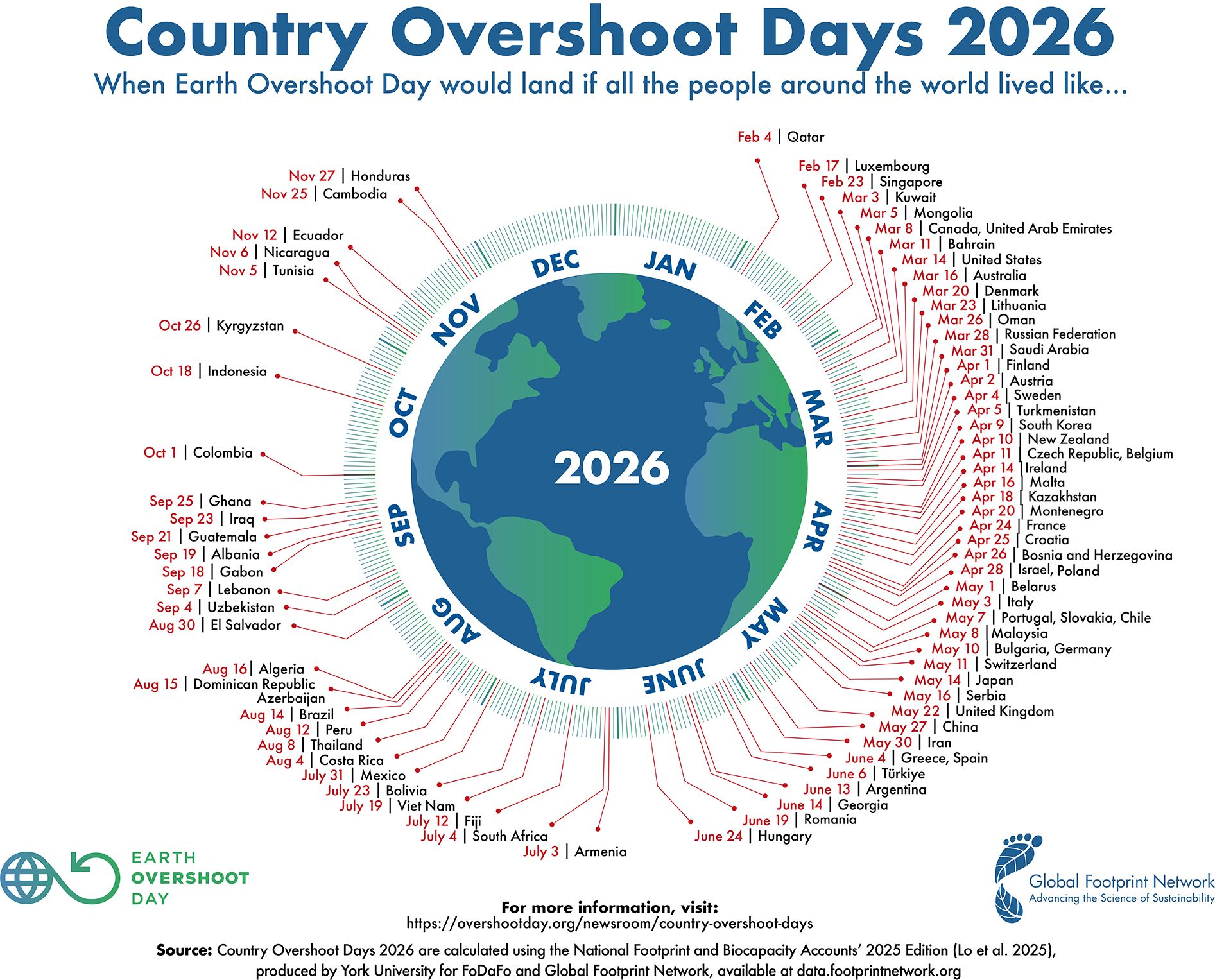
Country Overshoot Days 2026. You can download this illustration as a small jpg (size 450kb), a medium size jpg (size: 1.3Mb), a transparent gif (270kb), or a scalable pdf (size: 520kb). If you need a different format, contact media(at)footprintnetwork.org. Anyone is free to use the illustration as long as you credit it as: Global Footprint Network 2026, www.overshootday.org and www.footprintnetwork.org.
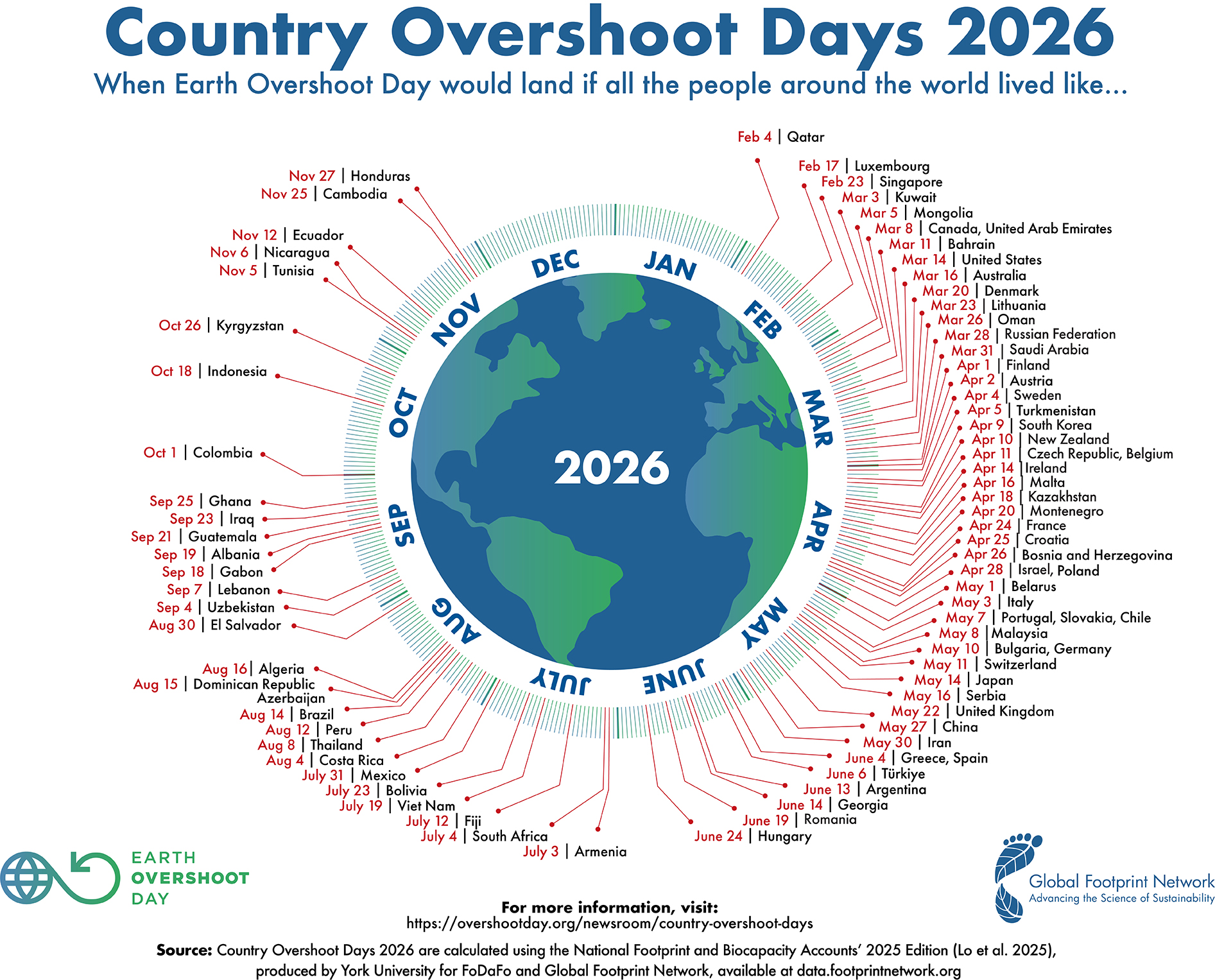
Country Overshoot Day Calendar & Calculations
A country’s overshoot day is the date on which Earth Overshoot Day would fall if all of humanity consumed like the people in that country.
Country overshoot days are published on January 1st of each year, using the latest year of the most recent National Footprint and Biocapacity Accounts edition. Therefore, the 2024 country overshoot days are based on the 2023 edition.
The 2023 edition provides results from 1961 to 2022. Due to varying time lags in data reporting from data input sources, results from 2020 to 2022 are based on a mixture of actual data and preliminary estimates. Like with preliminary estimates for GDP, preliminary estimates are not final and less robust than the estimates up to 2020, which are based on fully reported data sets. The details of the 2023 National Footprint and Biocapacity Accounts, including its most recent improvements, are described in the release notes from York University’s Ecological Footprint Initiative, which produces the accounts for FoDaFo.
Let’s take the Swiss Overshoot Day as an example. Its 2024 Overshoot Day is based on the latest available results from the 2023 edition of the National Footprint and Biocapacity Accounts. Given that the latest data point is for 2022, this would mean that the Swiss Overshoot Day 2024 really represents results for the year 2022:
- The Ecological Footprint of Switzerland was 3.74 global hectares (gha) per person in 2022.
- Global biocapacity was 1.51 gha per person in 2022.
Therefore in 2022, it took (3.74/ 1.51) = 2.5 Earths to support humanity if everyone on the planet lived like people in Switzerland.
Given that 2024 is a leap year, we can determine Swiss Overshoot Day using the equation 366 [days in 2024] * (1.51/3.74) = 148 [days]. In other words, after 148 days, the annual regenerative resource budget for the year would have been used up entirely. The 148th day of 2024 is May 27th.
Not all countries have an overshoot day, though. If a country’s Ecological Footprint per person is smaller than global biocapacity per person (1.5 gha), then the world would not use up the entire regenerative resource budget for the year within a year, if all humanity lived like them. These countries therefore do not have an overshoot day and are listed as “none” in the data tables, or are excluded as in the table below. In leap years, as is one this year, we calculate the date based on a 366 day-long year, rather than the usual 365.
You can also download the public data set with all the country results, including the dates of the Country Overshoot Days and the Country Ecological Deficit Days from here.

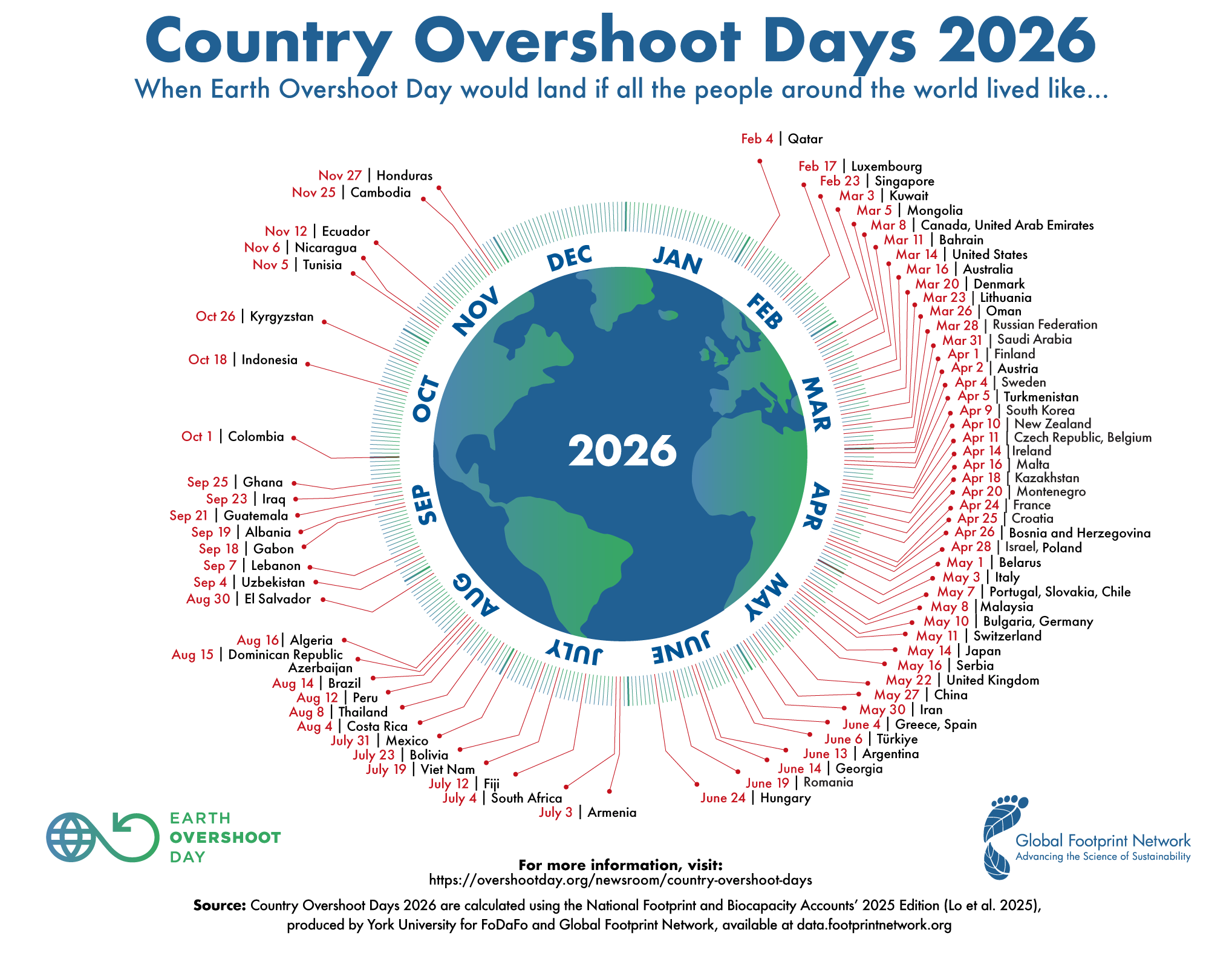
Country Overshoot Day Calendar & Calculations 2026
A country’s overshoot day marks the date when Earth Overshoot Day would fall if all of humanity consumed at the same level as the people in that country.
This complements a country’s deficit day, which refers to the date by which the residents of the country begin to demand more than their country’s ecosystems can provide in the entire year. Both days provide meaningful insight into a country’s performance.
Country Overshoot Days are published annually. They are made available at the end of December of the year prior, using the latest data from the most recent edition of the National Footprint and Biocapacity Accounts – which is now the 2025 edition. Earth Overshoot Day’s date is announced on World Environment Day (June 5).
Based on the 2025 edition of the National Footprint and Biocapacity Accounts
Country Overshoot Days for 2026 are based on the accounts’ 2025 edition. For most countries, the calculated dates reflect their 2024 situation, the latest data point currently available. The full 2025 edition was released on Earth Day 2025 (April 22) and was prepared by York University’s Ecological Footprint Initiative for Footprint Data Foundation (FoDaFo), the governing body of the National Footprint and Biocapacity Accounts.
The 2025 edition includes results from 1961 to 2024. Due to time lags in data reporting, results from 2022 to 2024 are based on a mix of actual data and preliminary estimates. These preliminary estimates, similar to GDP forecasts, are less robust than those for earlier years, which are based on fully reported data sets.
Detailed information on the 2025 edition, including methodological improvements and updated and revised data sets, are available here. For reference, you can access the release notes of the 2023 edition as well as the interim 2024 edition. Explanations about how shifts in the accounts have affected Country Overshoot Day estimates are explained here, using the example of the Netherlands.
To understand time trends, consult the latest official edition on the Footprint Data Platform. Its interactive map allows you to view country-specific trends from 1961 to the present.
At the bottom of the page, following the table of country overshoot dates, there is a brief explanation of the implications of using the newest data edition.
Example: Calculating Switzerland’s Overshoot Day
Switzerland’s 2026 Overshoot Day is based on data from the 2025 edition of the National Footprint and Biocapacity Accounts. Since the most recent data point is for 2024, Switzerland’s 2026 Overshoot Day reflects the country’s resource performance in 2024:
- Switzerland’s Ecological Footprint: 4.15 global hectares (gha) per person in 2024
- Global biocapacity: 1.48 gha per person in 2024
Thus, in 2024, humanity would need (4.15/ 1.48) = 2.8 Earths to support itself if everyone lived like the Swiss.
Since 2026 contains 365 days, we can determine Swiss Overshoot Day:
365 [days in 2026] * (1.48/4.15) = 130.1 [days].
This means humanity would have exhausted the annual regenerative resource budget the day after the 130th day of 2026, which is May 11th. Also note: using up the entire budget would leave nothing for wild species.
Results
Here, in Table 1, is the list of the Country Overshoot Days for 2026, for Switzerland and 85 other countries. It also lists the EU Overshoot Day for the European Union containing 27 countries. It will be on May 3 this year.
These dates were released in December 2025, and are based on the latest edition of the National Footprint and Biocapacity Accounts capturing the countries’ 2024 situation.
Table 1: Country Overshoot Days for 2026
| Country | Country Overshoot Day (for 2026) |
| Qatar | Wednesday, February 4, 2026 |
| Luxembourg | Tuesday, February 17, 2026 |
| Singapore | Monday, February 23, 2026 |
| Kuwait | Tuesday, March 3, 2026 |
| Mongolia | Thursday, March 5, 2026 |
| Canada | Sunday, March 8, 2026 |
| United Arab Emirates | Sunday, March 8, 2026 |
| Bahrain | Wednesday, March 11, 2026 |
| United States of America | Saturday, March 14, 2026 |
| Australia | Monday, March 16, 2026 |
| Denmark | Friday, March 20, 2026 |
| Lithuania | Monday, March 23, 2026 |
| Oman | Thursday, March 26, 2026 |
| Russian Federation | Saturday, March 28, 2026 |
| Saudi Arabia | Tuesday, March 31, 2026 |
| Finland | Wednesday, April 1, 2026 |
| Austria | Thursday, April 2, 2026 |
| Sweden | Saturday, April 4, 2026 |
| Turkmenistan | Sunday, April 5, 2026 |
| South Korea | Thursday, April 9, 2026 |
| New Zealand | Friday, April 10, 2026 |
| Czech Republic | Saturday, April 11, 2026 |
| Belgium | Saturday, April 11, 2026 |
| Ireland | Tuesday, April 14, 2026 |
| Malta | Thursday, April 16, 2026 |
| Kazakhstan | Saturday, April 18, 2026 |
| Montenegro | Monday, April 20, 2026 |
| France | Friday, April 24, 2026 |
| Croatia | Saturday, April 25, 2026 |
| Bosnia and Herzegovina | Sunday, April 26, 2026 |
| Israel | Tuesday, April 28, 2026 |
| Poland | Tuesday, April 28, 2026 |
| Belarus | Friday, May 1, 2026 |
| Italy | Sunday, May 3, 2026 |
| Portugal | Thursday, May 7, 2026 |
| Chile | Thursday, May 7, 2026 |
| Slovakia | Thursday, May 7, 2026 |
| Malaysia | Friday, May 8, 2026 |
| Bulgaria | Sunday, May 10, 2026 |
| Germany | Sunday, May 10, 2026 |
| Switzerland | Monday, May 11, 2026 |
| Japan | Thursday, May 14, 2026 |
| Serbia | Saturday, May 16, 2026 |
| United Kingdom | Friday, May 22, 2026 |
| China | Wednesday, May 27, 2026 |
| Iran, Islamic Republic of | Saturday, May 30, 2026 |
| Greece | Thursday, June 4, 2026 |
| Spain | Thursday, June 4, 2026 |
| Türkiye | Saturday, June 6, 2026 |
| Argentina | Saturday, June 13, 2026 |
| Georgia | Sunday, June 14, 2026 |
| Romania | Friday, June 19, 2026 |
| Hungary | Wednesday, June 24, 2026 |
| Armenia | Friday, July 3, 2026 |
| South Africa | Saturday, July 4, 2026 |
| Fiji | Sunday, July 12, 2026 |
| Viet Nam | Sunday, July 19, 2026 |
| Bolivia | Thursday, July 23, 2026 |
| Mexico | Friday, July 31, 2026 |
| Costa Rica | Tuesday, August 4, 2026 |
| Thailand | Saturday, August 8, 2026 |
| Peru | Wednesday, August 12, 2026 |
| Brazil | Friday, August 14, 2026 |
| Dominican Republic | Saturday, August 15, 2026 |
| Azerbaijan | Saturday, August 15, 2026 |
| Algeria | Sunday, August 16, 2026 |
| El Salvador | Sunday, August 30, 2026 |
| Uzbekistan | Friday, September 4, 2026 |
| Lebanon | Monday, September 7, 2026 |
| Gabon | Friday, September 18, 2026 |
| Albania | Saturday, September 19, 2026 |
| Guatemala | Monday, September 21, 2026 |
| Iraq | Wednesday, September 23, 2026 |
| Ghana | Friday, September 25, 2026 |
| Colombia | Thursday, October 1, 2026 |
| Indonesia | Sunday, October 18, 2026 |
| Kyrgyzstan | Monday, October 26, 2026 |
| Tunisia | Thursday, November 5, 2026 |
| Nicaragua | Friday, November 6, 2026 |
| Ecuador | Thursday, November 12, 2026 |
| Cambodia | Wednesday, November 25, 2026 |
| Honduras | Friday, November 27, 2026 |
Countries Not Included in the Above Table
If a country’s Ecological Footprint per person is smaller than global biocapacity per person (1.48 gha), humanity would not exceed the planet’s regenerative capacity within a year if everyone consumed like that country. These countries are therefore omitted from the figure at the top and from table 1 above. 13 of them are listed below in table 2 which also shows what percentage of Earth would be used if everyone around the world lived as the residents of those countries.
Some additional countries are also excluded due to incomplete or unreliable data, as data quality varies across UN datasets. These are countries which the National Footprint and Biocapacity Accounts identify with a with a low data quality score. For this reason, the 2026 Country Overshoot Days excludes the following countries: Bhutan, Botswana, Cuba, Cyprus, Estonia, Guyana, Iceland, Latvia, Mauritius, Morocco, Namibia, the Netherlands, Norway, Panama, Slovenia, Trinidad and Tobago, Uruguay, and Venezuela, plus a few smaller countries, since their output data are not passing some basic quality tests.
Many of the excluded countries have economies with relatively large trade flows compared to their size, which introduces significant noise into the results of this edition of the National Footprint and Biocapacity Accounts. This issue is particularly pronounced because trade data appear to be among the noisiest datasets reported to the UN. The problem may be further amplified by the recent adoption of upgraded classification systems for UN trade statistics. As a result, it is often unclear whether unexpected outcomes reflect real underlying changes, data inconsistencies, input errors, or limitations in the calculation algorithms. For these reasons, data for these excluded countries from this edition are used exclusively for research collaborations, with the expectation that some of these issues can be addressed in the 2026 edition.
You can download the 2025 edition public dataset with country results. The 2026 edition should be available by Earth Day 2026, and will form the basis for the Country Overshoot Days 2027. Also note: In leap years, like 2024 or 2028, calculations are adjusted for a 366-day year instead of 365.
Table 2: Countries without an Country Overshoot Day in 2026. These are countries with their current per person consumption Footprints smaller than the world’s per person biocapacity.
| Country | Portion of Earth required if everyone lived like… |
| Bangladesh | 46% |
| Nigeria | 53% |
| Nepal | 55% |
| Ethiopia | 60% |
| Kenya | 61% |
| Tanzania | 67% |
| Côte d’Ivoire | 74% |
| India | 75% |
| Sri Lanka | 81% |
| Egypt | 88% |
| Jordan | 89% |
| Philippines | 94% |
| Senegal | 99% |
How Have Country Overshoot Days Changed Over Time?
To analyze trends in Country Overshoot Days, consult the Footprint Data Platform, which provides consistent time series data, all based on the same National Footprint and Biocapacity Accounts edition.
Comparing Country Overshoot Days across different editions comes with a challenge. Because some change results from improvements in underlying data, some from sharpened accounting algorithms, and the remainder from actual shifts in consumption. This is explained using the example of the Netherlands here. These are key changes in data input from the 2023 edition to the 2025 edition:
- Agricultural area data: Updates to grazing land and cropland statistics from the UN FAO ResourceStat.
- Global Carbon Budget data: Revised estimates for oceanic carbon uptake.
- Trade classifications: Adjustments in carbon embodied in trade due to restructuring in UN Comtrade datasets.
For this edition change, the change due to different input data is larger for most countries than the actual change due to shifts in consumption. For clarity, the table below shows how much change in overshoot dates for 2022 is driven by:
- Updates in input data and methodology (5th column in table 3 below) (the difference between the 2022 results in the 2023 edition versus the 2022 results in the 2025 edition), versus
- Real shifts in consumption patterns (6th column in table 3 below) (the difference between 2023 and 2024 in the 2025 edition).
The data-input-driven change can be assessed by comparing the 2022 results from the 2023 edition with those of the 2025 edition. The consumption change can be determined by comparing results for 2023 and 2024 within the preliminary 2025 edition. For deeper insights, visit the Footprint Data Platform, which show the 2025 edition.
Table 3: Dates of Country Overshoot Days in 2026 and changes due to updated data inputs and due to country’s actual change of consumption levels, plus additional info such as number of Earths, and days to Overshoot Day. Essentially, table 3 expands on table 1.
| Country | Country Overshoot Day (for 2026) | Number of Earths required | Number of Days to Overshoot Day | Days earlier than the previous year due to changes in data | Days earlier than the previous year due to changes in consumption |
| Qatar | Wednesday, February 4, 2026 | 10 | 35 | 7 | 1 |
| Luxembourg | Tuesday, February 17, 2026 | 7.7 | 48 | 4 | -1 |
| Singapore | Monday, February 23, 2026 | 6.8 | 54 | 41 | 0 |
| Kuwait | Tuesday, March 3, 2026 | 6.0 | 61 | 2 | 1 |
| Mongolia | Thursday, March 5, 2026 | 5.8 | 63 | 8 | 0 |
| Canada | Sunday, March 8, 2026 | 5.5 | 67 | 9 | 0 |
| United Arab Emirates | Sunday, March 8, 2026 | 5.5 | 67 | -4 | 3 |
| Bahrain | Wednesday, March 11, 2026 | 5.3 | 69 | -3 | 3 |
| United States of America | Saturday, March 14, 2026 | 5.1 | 72 | 2 | -1 |
| Australia | Monday, March 16, 2026 | 4.9 | 74 | 24 | -1 |
| Denmark | Friday, March 20, 2026 | 4.7 | 78 | -1 | 0 |
| Lithuania | Monday, March 23, 2026 | 4.5 | 82 | 3 | 2 |
| Oman | Thursday, March 26, 2026 | 4.3 | 84 | -9 | 0 |
| Russian Federation | Saturday, March 28, 2026 | 4.2 | 87 | 9 | 3 |
| Saudi Arabia | Tuesday, March 31, 2026 | 4.1 | 89 | 6 | 0 |
| Finland | Wednesday, April 1, 2026 | 4.1 | 90 | 11 | -1 |
| Austria | Thursday, April 2, 2026 | 4.0 | 91 | 6 | 0 |
| Sweden | Saturday, April 4, 2026 | 3.9 | 93 | 17 | -1 |
| Turkmenistan | Sunday, April 5, 2026 | 3.9 | 94 | 48 | -3 |
| South Korea | Thursday, April 9, 2026 | 3.7 | 99 | -5 | 0 |
| New Zealand | Friday, April 10, 2026 | 3.7 | 99 | 10 | -1 |
| Czech Republic | Saturday, April 11, 2026 | 3.6 | 100 | 8 | -1 |
| Belgium | Saturday, April 11, 2026 | 3.6 | 100 | -18 | 0 |
| Ireland | Tuesday, April 14, 2026 | 3.5 | 103 | 20 | -2 |
| Malta | Thursday, April 16, 2026 | 3.5 | 105 | 38 | 1 |
| Kazakhstan | Saturday, April 18, 2026 | 3.4 | 108 | 21 | 3 |
| Montenegro | Monday, April 20, 2026 | 3.3 | 110 | 36 | 4 |
| France | Friday, April 24, 2026 | 3.2 | 113 | 14 | -1 |
| Croatia | Saturday, April 25, 2026 | 3.2 | 114 | 32 | 1 |
| Bosnia and Herzegovina | Sunday, April 26, 2026 | 3.2 | 115 | 12 | 0 |
| Israel | Tuesday, April 28, 2026 | 3.1 | 118 | 12 | -2 |
| Poland | Tuesday, April 28, 2026 | 3.1 | 118 | 2 | 3 |
| Belarus | Friday, May 1, 2026 | 3.0 | 120 | 0 | 1 |
| Italy | Sunday, May 3, 2026 | 3.0 | 123 | 16 | 1 |
| Portugal | Thursday, May 7, 2026 | 2.9 | 126 | 19 | 0 |
| Chile | Thursday, May 7, 2026 | 2.9 | 126 | 18 | 2 |
| Slovakia | Thursday, May 7, 2026 | 2.9 | 127 | 5 | 2 |
| Malaysia | Friday, May 8, 2026 | 2.9 | 127 | 2 | 3 |
| Bulgaria | Sunday, May 10, 2026 | 2.8 | 129 | 26 | -1 |
| Germany | Sunday, May 10, 2026 | 2.8 | 129 | -7 | -1 |
| Switzerland | Monday, May 11, 2026 | 2.8 | 130 | 13 | -1 |
| Japan | Thursday, May 14, 2026 | 2.7 | 134 | 0 | 1 |
| Serbia | Saturday, May 16, 2026 | 2.7 | 136 | 11 | 4 |
| United Kingdom | Friday, May 22, 2026 | 2.6 | 142 | 10 | 0 |
| China | Wednesday, May 27, 2026 | 2.5 | 147 | 6 | 4 |
| Iran, Islamic Republic of | Saturday, May 30, 2026 | 2.4 | 149 | 20 | 2 |
| Greece | Thursday, June 4, 2026 | 2.4 | 154 | -12 | 0 |
| Spain | Thursday, June 4, 2026 | 2.4 | 155 | -12 | 0 |
| Türkiye | Saturday, June 6, 2026 | 2.3 | 156 | 7 | 1 |
| Argentina | Saturday, June 13, 2026 | 2.2 | 164 | 15 | -1 |
| Georgia | Sunday, June 14, 2026 | 2.2 | 164 | 39 | 8 |
| Romania | Friday, June 19, 2026 | 2.1 | 170 | 31 | 4 |
| Hungary | Wednesday, June 24, 2026 | 2.1 | 174 | -27 | 3 |
| Armenia | Friday, July 3, 2026 | 2.0 | 183 | 48 | 11 |
| South Africa | Saturday, July 4, 2026 | 2.0 | 184 | -12 | -3 |
| Fiji | Sunday, July 12, 2026 | 1.9 | 192 | -2 | -1 |
| Viet Nam | Sunday, July 19, 2026 | 1.8 | 200 | 27 | 11 |
| Bolivia | Thursday, July 23, 2026 | 1.8 | 204 | -2 | -2 |
| Mexico | Friday, July 31, 2026 | 1.7 | 212 | 29 | -1 |
| Costa Rica | Tuesday, August 4, 2026 | 1.7 | 216 | 1 | 0 |
| Thailand | Saturday, August 8, 2026 | 1.7 | 220 | 16 | 6 |
| Peru | Wednesday, August 12, 2026 | 1.6 | 224 | 23 | -1 |
| Brazil | Friday, August 14, 2026 | 1.6 | 226 | -6 | 1 |
| Dominican Republic | Saturday, August 15, 2026 | 1.6 | 226 | 78 | 1 |
| Azerbaijan | Saturday, August 15, 2026 | 1.6 | 226 | 5 | 5 |
| Algeria | Sunday, August 16, 2026 | 1.6 | 228 | 18 | 5 |
| El Salvador | Sunday, August 30, 2026 | 1.5 | 242 | 32 | 2 |
| Uzbekistan | Friday, September 4, 2026 | 1.5 | 246 | 15 | 2 |
| Lebanon | Monday, September 7, 2026 | 1.5 | 250 | -76 | 8 |
| Gabon | Friday, September 18, 2026 | 1.4 | 261 | 2 | -1 |
| Albania | Saturday, September 19, 2026 | 1.4 | 262 | 2 | -1 |
| Guatemala | Monday, September 21, 2026 | 1.4 | 264 | 28 | -2 |
| Iraq | Wednesday, September 23, 2026 | 1.4 | 265 | 52 | 4 |
| Ghana | Friday, September 25, 2026 | 1.4 | 267 | 45 | -1 |
| Colombia | Thursday, October 1, 2026 | 1.3 | 274 | 3 | 4 |
| Indonesia | Sunday, October 18, 2026 | 1.3 | 291 | 38 | 5 |
| Kyrgyzstan | Monday, October 26, 2026 | 1.2 | 299 | 63 | -2 |
| Tunisia | Thursday, November 5, 2026 | 1.2 | 308 | 92 | 4 |
| Nicaragua | Friday, November 6, 2026 | 1.2 | 310 | 60 | -2 |
| Ecuador | Thursday, November 12, 2026 | 1.2 | 315 | 19 | -4 |
| Cambodia | Wednesday, November 25, 2026 | 1.1 | 328 | 81 | 12 |
| Honduras | Friday, November 27, 2026 | 1.1 | 331 | 79 | 0 |
Additional Resources
Country Deficit Day
Country data on Footprint Data Platform
Interview about Country Overshoot Day
How edition changes shift historical Country Overshoot Days
Earth Overshoot Day
About the Ecological Footprint
About Country Overshoot Days
Sign up for Global Footprint Network’s Newsletter